
Industries · Chemical
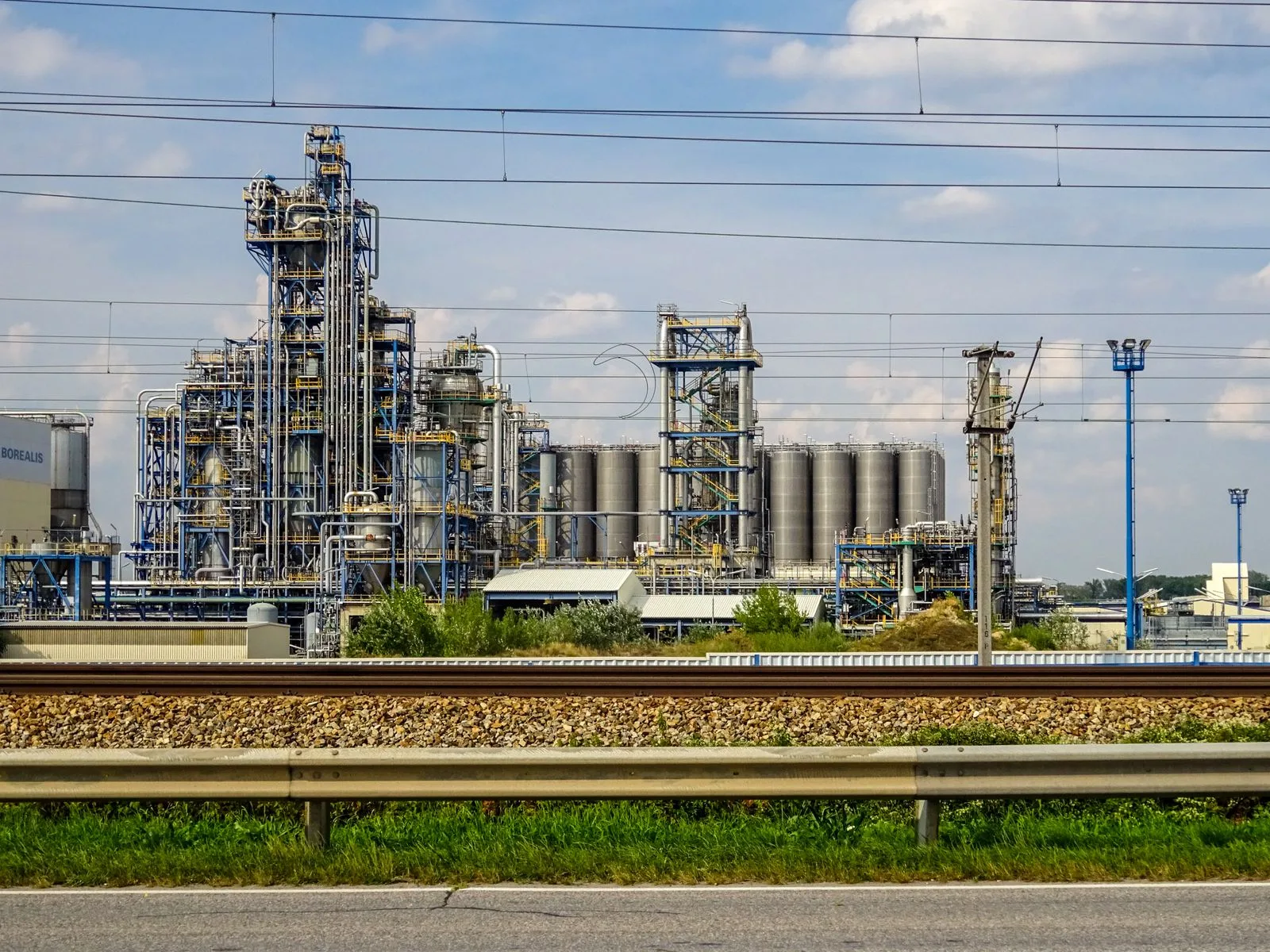
Cooling Towers for the Chemical Industry
Corrosion-resistant FRP, RCC and wooden cooling towers, thermally designed for reactor, condenser and heat exchanger duty in chemical plants. Made at our own factory near Mumbai since 1975.
- Corrosion-proof FRP
- Counterflow & crossflow
- CTI member · ISO 9001:2015
- 4,900+ towers supplied
Quick answer
What cooling tower is best for a chemical plant?
For most chemical plants, an induced draft FRP cooling tower is the best fit. FRP does not rust, so it holds up against acidic fumes, chemical-laden air and hard or poor-quality make-up water that corrode steel towers. Pair it with PVC fill, polypropylene nozzles and stainless steel or hot-dip galvanised hardware for a fully corrosion-resistant tower.
Very large, permanent installations often choose an RCC cooling tower for its long-life concrete structure. Either way, the tower should be thermally designed for your circulating flow, hot and cold water temperatures and site wet-bulb temperature.
Applications
Where cooling towers are used in chemical plants
Chemical processes release large amounts of heat, and most of it is rejected through the cooling water circuit. A cooling tower keeps that water at the temperature your process needs.
Reactor jacket and coil cooling
Removes heat from exothermic reactions so batch and continuous reactors stay at a safe, stable temperature.
Distillation condensers
Supplies cold water to overhead condensers that turn vapour back into liquid during separation and solvent recovery.
Process heat exchangers
Feeds shell-and-tube and plate heat exchangers that cool products, intermediates and process streams.
Compressors and chillers
Cools gas compressors, refrigeration plants and chiller condensers that serve the process.
Vacuum systems
Provides cooling water for vacuum pumps, ejectors and barometric condensers used in evaporation and drying.
Utilities and DG sets
Handles cooling for captive power, DG sets, air compressors and other plant utilities.
Challenges
Cooling tower challenges in the chemical industry, and how we design for them
A tower that works well at a food plant can fail early at a chemical plant. These are the conditions we design around.
Challenge
Corrosive fumes and chemical-laden air
How we design for it
FRP structure, casing and fan cylinder that cannot rust, with stainless steel or hot-dip galvanised hardware.
Challenge
Scaling and fouling from poor make-up water
How we design for it
Film or splash fill selected to suit your water analysis; splash fill tolerates dirtier water with less clogging.
Challenge
Process contamination of the cooling water
How we design for it
Tell us which chemicals could enter the circuit and we check the compatibility of fill, nozzles and structural materials.
Challenge
Drift carrying treated or contaminated water
How we design for it
PVC cellular or blade-type drift eliminators to limit water carried out of the tower.
Challenge
Continuous, round-the-clock operation
How we design for it
Multi-cell designs so one cell can be serviced while the others keep running, plus spares from the same manufacturer.
Challenge
Space limits in congested plants
How we design for it
Compact counterflow cells, or crossflow cells with low pumping head, sized to your available area.
Tower types & materials
Which cooling tower suits your chemical plant?
We manufacture all three materials in-house, so we recommend the one that fits your duty, not the one we happen to make.
| Feature | FRP cooling tower | RCC cooling tower | Wooden cooling tower |
|---|---|---|---|
| Best for | Most chemical process duties | Large, permanent plants | Economical large process cooling |
| Corrosion resistance | Excellent – no rust; suits chemical, coastal and seawater duty | Very good – concrete structure with HDG / SS hardware | Good – CCA-treated timber with HDG / SS hardware |
| Models | 98 | 92 | 107 |
| Capacity | Up to 6,000 m³/hr per cell (pultruded) | Sized to project | 45 – 5,000 m³/hr per cell |
| Civil work | Minimal – FRP or RCC cold water basin | Civil structure built locally from our drawings | RCC cold water basin by purchaser (drawings provided) |
Every wetted and exposed part is chosen to resist corrosion. Final materials are confirmed against your water analysis and the chemicals present on site.
| Component | Material of construction |
|---|---|
| Structure and casing | FRP (or RCC / treated timber) |
| Fill | PVC film or splash fill |
| Drift eliminator | PVC, cellular or blade type |
| Nozzles | Polypropylene (PP) |
| Hardware | Stainless steel or hot-dip galvanised MS |
| Fan | Cast aluminium alloy or GRP blades |
| Fan cylinder | FRP |
| Electric motor | To suit your site standards and area classification |
How it works
What we need to size your cooling tower
Send these details and our engineers will recommend the model, number of cells and fill for guaranteed performance.
Flow rate
Circulating water flow in m³/hr, or heat load in kW or TR.
Temperatures
Hot water inlet and required cold water outlet temperatures.
Wet-bulb temperature
Design wet-bulb temperature for your site location.
Water and chemicals
Make-up water analysis and any chemicals that could enter the circuit.
Site details
Available space, existing basin, power supply and site standards.
Why Cooltech
Trusted by chemical and process plants since 1975
Our clients include Rashtriya Chemicals & Fertilizers and Orchid Chemicals & Pharmaceuticals, alongside plants across the Middle East, Southeast Asia and Africa.
years designing cooling towers
cooling towers manufactured
towers exported
member · ISO 9001:2015
FAQ
Cooling towers for chemical plants: FAQs
Which type of cooling tower is best for a chemical plant?
An induced draft FRP cooling tower suits most chemical plants because FRP cannot rust in corrosive, humid air. For very large, permanent installations an RCC cooling tower is also a strong choice. Counterflow designs give high performance in a small footprint, while crossflow designs are easier to inspect and clean.
What information do you need to size a cooling tower for a chemical process?
We need the circulating flow rate (or heat load), hot and cold water temperatures, the design wet-bulb temperature for your site, your make-up water analysis, and details of the available space and power supply.
How do you protect a cooling tower from corrosive chemical fumes?
We use corrosion-resistant materials throughout: an FRP structure and fan cylinder, PVC fill and drift eliminators, polypropylene nozzles and stainless steel or hot-dip galvanised hardware.
What if process chemicals leak into the cooling water?
A cooling tower cannot stop a heat exchanger leak, but it can be built from materials that tolerate it. Tell us which chemicals could enter the circuit during design, and we will confirm that the fill, nozzles and structure are compatible.
Can you repair or rebuild an existing cooling tower at our chemical plant?
Yes. We repair and reconstruct cooling towers of any make, and supply spares such as FRP fans, fills, nozzles, drift eliminators, fan stacks and gearboxes.
Do you supply cooling towers to chemical plants outside India?
Yes. We have exported more than 1,500 cooling towers to the Middle East, Southeast Asia and Africa. Our factory at MIDC Murbad is close to JNPT port for fast shipping.
Related industries
Cooling towers for related industries
Cooling towers for petrochemical plants
Cooling towers for pharmaceutical industry
Cooling towers for fertilizer plants
Our clients
Clients who trust Cooltech
Industry leaders in India and abroad rely on Cooltech cooling towers.


Need a cooling tower for your chemical plant?
Share your flow rate, temperatures and site details. Our engineers will recommend the right FRP, RCC or wooden cooling tower.